All posts by Watershed Planner

Feb11_2026

❄️❄️ Provincial snowpack check-in: 95% of normal in the Boundary—here’s what that does (and doesn’t) tell us❄️❄️

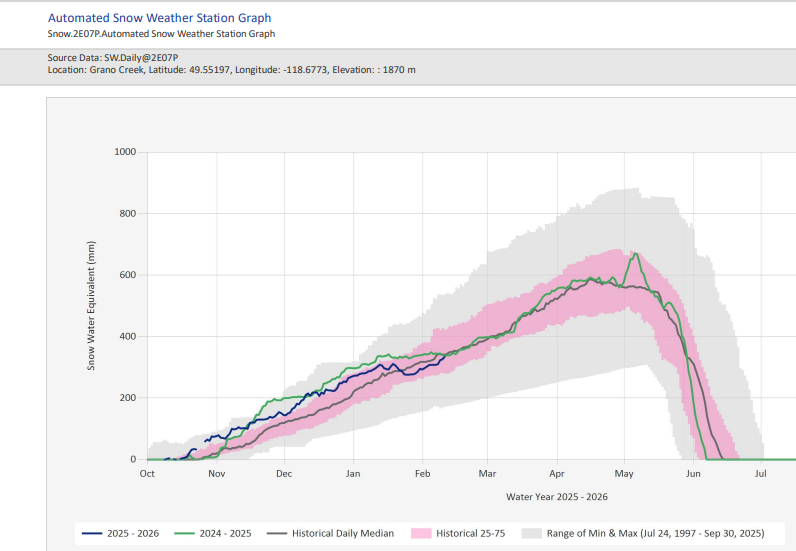
BC Snow Survey update (February 2026): The provincial snow monitoring report for February is now posted. It shows the Boundary Region at 95% of normal (https://www2.gov.bc.ca/…/river-forecast/2026_feb1.pdf) … but is that the whole story?

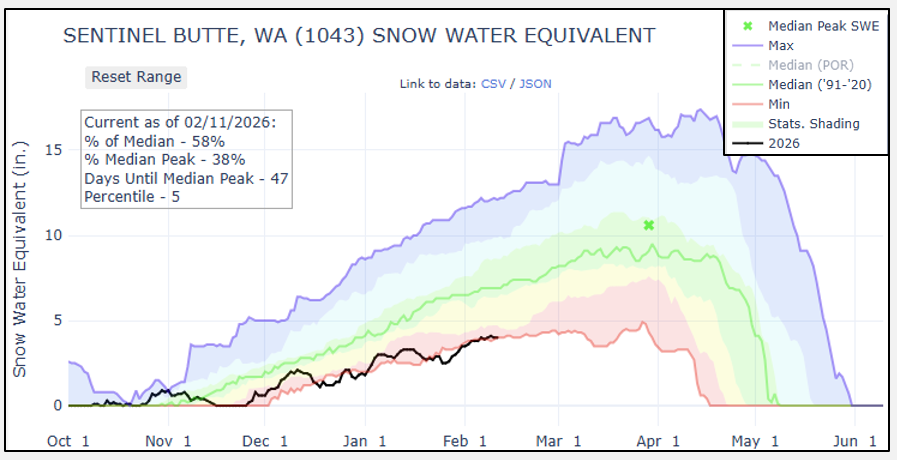
🏔️ A quick note on what this number represents: it’s based mainly on higher-elevation snow stations—Grano Creek (1870 m) and Big White (manual station at 1680 m). It doesn’t capture what we’re seeing at mid to lower elevations, where snow has been very limited—no snow in Grand Forks (520 m) to low snow near Sentinel Butte (1500 m, south of Grand Forks). https://www.nwrfc.noaa.gov/snow/ Two additional snow stations (manual) may be included in the BC spring snow survey update: Carmi (1250 m) and Monashee Pass (1370 m).
** For elevation comparison the highway summit at Paulson/Bonanza Pass is 1535m.

Because we’re still a few months away from the usual peak snowpack period, it’s too early to say what spring melt will look like. Spring conditions depend not just on how much snow we have, but also on temperatures and spring rainfall.

🗓️ Looking ahead: Environment and Climate Change Canada outlooks continue to indicate warmer-than-normal conditions over the next few months. Longer-range climate signals (ENSO—La Niña/El Niño) are also evolving, which can influence the likelihood of hotter/drier summer patterns—but there’s still a lot of uncertainty.
ENSO forecast: https://iri.columbia.edu/…/climate/forecasts/enso/current/
ECCC Probabilistic forecast: https://weather.gc.ca/saisons/prob_e.html

💬 One thing we often see in the Boundary is that a “low snow year” at one elevation doesn’t always line up with other elevations. You can see that in the low-snow years recorded at different monitoring stations:
• Sentinel Butte Stn (@ 1500 m): 2005 and 2015
• Grano Creek Stn (@ 1870 m): 2014 and 2019

https://www.facebook.com/BIWS.RDKB
What low-snow winters stand out in your memory in the Boundary?
Are you noticing increased river and/or groundwater well levels compared to normal?
How are these snow conditions affecting you?

https://www2.gov.bc.ca/…/river-forecast/2026_feb1.pdf
https://www.nwrfc.noaa.gov/snow/snowplot.cgi?SENW1

To get information on the BC snow monitoring stations, go to the “Snow Survey Stations Interactive Maps”. To access the Grano Creek Station map directly, go to: bcmoe-prod.aquaticinformatics.net/Report/Show/
Snow.2E07P.Automated%20Snow%20Weather%20Station%20Graph/

Algae: Slippery Season in the Kettle and what they tell us about Watershed Health

This entry is part 8 of 8 in the series The Messy River Series

At this time of year, our rivers, lakes, and ponds often run low and warm — and, for many, that means algae! The first sign is someone yelling, “Those rocks are slippery!”

But what actually is algae? Why do some waterways have it and others don’t? Is it harmful? Helpful? How does it fit into the story of our messy rivers? So many questions for such a simple-sounding organism.

Phycology — the study of algae — reveals that the answer isn’t simple at all. As Wetland Ecologist, Carol Fischer, a resident of Greenwood explains: 

“When most people hear about algae, they think of the green “stuff” floating in the water and assume that it is part of the plant kingdom and this may or may not be true for some algae.  Scientists are still debating where these organisms fit in.  Algae have many characteristics of plants, but they are also lacking some pretty important structures that would put them firmly in the plant kingdom.  Other types of algae have characteristics of Protists (single-celled organisms) and some even have characteristics of Fungi (think mushrooms). To make things even more complicated, when evolutionary biologists study algae at the molecular level, it appears that some types are actually genetically closer to protists and fungi than to other algae! Something that looks so simple and familiar is actually a scientific mystery still waiting to be solved.

Algae is a vital part of aquatic ecosystems, forming the base of the food web. It produces oxygen through photosynthesis, fuels nutrient cycling, and can even provide shelter for tiny fish and aquatic insects. Unfortunately, harmful algae blooms have given the whole group a bad reputation. In some cases, it’s not even the algae itself that causes problems, but the bacteria that flourish when heavy growth occurs.

Whether algae thrives in a particular waterway depends on a combination of factors: nutrient availability, water flow, sunlight, and the presence of grazers (like aquatic insects and snails).

Picture two creeks side by side:

  • One is (a Messy Creek) shaded by healthy riparian vegetation, with normal nutrient levels and a good population of grazers. Here, algae is present but balanced — part of a healthy system.
  • The other has lost its riparian cover, receives excess nutrients, and has few grazers. Here, algae grows unchecked, creating mats that smother habitat and upset the ecosystem’s balance.

So next time you step carefully on those slick river rocks, remember — in the right amounts, algae are part of what makes our rivers vibrant and alive; and think about the necessary components of a river to keep it in balance. Our messy rivers, with their mix of habitats, flows, and food webs, help keep algae populations in check and ecosystems in balance.

What You Can Do

  • Maintain natural vegetation along shorelines and streambanks to shade water and filter runoff. A healthy riparian buffer would be 30 meters in width.
  • Reduce the use of fertilizers near water — even small amounts can boost algae growth.
  • Keep septic systems in good repair.
  • Support watershed protection efforts in your community.
  • To learn more about algae in British Columbia, visit the BC government’s Algae Watch page.
  • Prevent the spread of invasive algae https://bcinvasives.ca/play-your-part/clean-drain-dry/
  • You can also explore local water stewardship projects at kettleriver.ca.

The Small Things That Hold the River Together

This entry is part 7 of 8 in the series The Messy River Series

Where would the periwinkles go — those tiny, case-making caddisfly larvae — if it weren’t for our messy rivers?

These remarkable aquatic insects spin silk, just like butterflies and moths. But instead of building cocoons in trees, they use their silk to glue together pieces of the river: tiny twigs, grains of sand, bits of leaf litter. Their protective cases become moving fortresses, each one reflecting the stream it came from. Without leaf packs, without quiet eddies, without the complexity — there would be no place for caddisflies to live, hide, or grow.

And they’re just the beginning. Insects are foundational to river ecosystems. We might not notice them on a casual walk, but they are everywhere — swimming, clinging, hatching, feeding. They are the pulse beneath the surface.

You don’t have to be an entomologist to care.
The flyfisher(wo)man learns the hatching cycles by heart.
The gardener thanks pollinators while battling pests.
The child watches, wide-eyed, as a water strider skips like magic across a pool.
Even the honey lover, spooning golden sweetness onto morning toast, is connected to the quiet work of riverside insects.

Here in the Kettle River Watershed, our insects are not only active — they are remarkable. The shimmering River Jewelwing, a damselfly with black wings and metallic green body, is known from only three locations in British Columbia — one of them right here on Christina Creek. It flutters low along the streambanks in summer, catching sunlight and midges in equal measure. Then there’s the Giant Water Bug, which looks more like a creature from science fiction than something found under a rock in a roadside ditch. With piercing mouthparts and strong front legs, it is both predator and prey — a vital part of the aquatic food web. Add to that the hidden world of stoneflies, dragonflies, water boatmen, mayflies, and predaceous diving beetles, and you begin to glimpse into the sheer richness of insect life beneath our feet.

They feed birds. They feed fish. They break down leaf litter. They even help us gauge the health of our waterways. Certain species vanish when water quality declines — others can only live in intact riparian zones.

And what do they need from us? Mostly, to leave things messy.

Brushy banks. Slow pools. Logs in the water. Shade. Floodplains that breathe and shift with the seasons.

So next time you see a jumble of branches, a muddy side channel, or a ditch that hums with life in spring — resist the urge to tidy it.

For the ladies out there, who love the idea of integrated learning, come out for our flyfishing experience for women only and learn more about these incredible critters through the lens of fish. September 12th, more information at kettleriver.ca/events/fly-fishing-experience-women-only/.