Category Archives: Local Conditions

Jun8 conditions

Drought monitoring has started earlier this year. Below is the link to the June 8th 2023 Drought Update for the Boundary Region. The RDKB Watershed Service will be attending Provincial Drought biweekly meetings throughout the summer. If you have any drought concerns you would like RDKB to report, please email: [email protected].

Provincial Drought Levels for June 8, 2023

  • Kettle River Watershed: Level 2 (very dry)
  • Okanagan River Watershed: Level 2 (very dry)

As you have likely heard on the news, British Columbia (including the Boundary Region) is forecasted to experience a very hot summer this year.  We are being warned about increased risk of drought (water scarcity) conditions and wildfire potential. Realizing that many rely on June rains to support their watering needs, it is recommended that you plan for reduced spring rains. Also be aware that even normal amounts of rain may not be enough to counter the evaporation (evapotranspiration) that can occur from unusually high air temperatures, resulting in reduced ground moisture and lower water levels.

If you receive your water from a Water Supplier (such as Irrigation District, municipality, community water system, etc) please check with your Water Supplier throughout the summer months to determine what water restriction might be in place for your region. Acknowledging that Provincial Drought Levels are identified as one level covering a large watershed area (ie. Kettle and Okanagan River watersheds) and may not be representative to conditions occurring in your water catchment zone.

Maintaining a healthy watershed needs all of us working together, especially during these more difficult times. As identified in the goals and vision from the Kettle River Watershed Management Plan, healthy watersheds provide beneficial ecosystem services, which in turn support our communities, economy, and environment. Being water conscious during times of drought is what we need to do to minimize the impacts of water scarcity on our ecosystems and aquatic organisms, which in turn support healthy watersheds fostering resilience and long-term sustainability.    

Many of our plant nurseries have information on drought tolerant plants, lawn alternatives and FireSmart options. Consider reducing your water-intensive plants (crops, trees, lawn, etc), shifting to more drought tolerant options; consider xeriscaping. Look at establishing drought tolerant FireSmart approved shade trees on your property – perhaps adjacent to impermeable surfaces to reduce heat reflection (remembering roots can impact underground lines). Consider using native plants to restore and protect riparian areas, as these can lessen water scarcity impacts during mild drought conditions. There are many documents supporting drought management for the Agricultural community, see the links below.

Be WaterSmart and FireSmart. Prepare for the potential of very dry conditions coming over the next few months. Water is a necessary and valuable resource; success can only happen by us working together and continuing to use water efficiently.

For more information on the changing drought conditions, check out the BC Drought Information Portal and local condition on the RDKB website: https://kettleriver.ca/category/conditions/drought/.

Some additional sites and documents:

Water Quality Testing

When testing your drinking water quality, there are many components that you may want/need to test for, such as Biological (ie. coliform, E.coli, etc), Total Metals (ie. arsenic, Lead, etc), Chemical (ie. hardness, pH, etc) and Anions (ie. nitrates, sulfates, etc).

Most people’s first concern is biological contamination, E.coli. To understand potential risk from biological contamination, testing may need to happen regularly as the presence of biological contamination can be easily influenced by moving water (both surface and shallow groundwater). This is why Interior Health often recommended to those using surface water (ie. Christina Lake, Kettle River, etc) and water from unconfined aquifers (shallower aquifers that are directly connected to surface sources) to treat their drinking water, protecting themselves from biological contamination.

Water quality testing in the Boundary Region

Talk to your lab to see which tests they are able to complete. For most tests, the lab will send you the containers you need to collect the water in and instructions on the conditions the water sample must meet to ensure accurate test results, including the length of time allowed between taking the sample and getting the sample to the lab for testing.

Y&R Water (Grand Forks):  https://www.yrwater.ca/water-testing.html

Caro Analytics (Kelowna): https://www.caro.ca/

Passmore Labs (Winlaw): http://passmorelaboratory.ca/

Interior Health supports water quality testing for Water Suppliers and Businesses who are required by regulation to complete regular drinking water testing and reporting.

The RDKB does not recommend or endorse any contractor and consulting organizations, these names are provided as information only. If you know of any more water quality testing companies that should be included, please contact [email protected].

October Drought Conditions

The Province has just increased the drought level for the Okanagan River Basin to a Level 2 (very dry) and the Kettle River Basin to a level 5 (exceptionally dry). Within the Kettle Basin the two more southern sub-basins (Middle Kettle and Lower Kettle) have increased to a level 4, with the west and northern sub-basins at a level 5. BC Drought Information Portal

With the anticipation of rain continuing this week, the hope is that there will be enough precipitation to bring our stream water levels back to a normal level for this time of year.

If you have any comments, observations and/or concerns in your region that you would like the RDKB to pass on to the Province in support of their reviews, please email them to: [email protected].

With this changing climate, we need to prepare now as it is likely we will start seeing these dry conditions more often. The RDKB is encouraging people to think about how they can reduce their water needs and strengthen their private distribution system to minimize water waste.

Click below to see what residents in the Boundary are already doing to reduce their personal water needs:

Summary of actions already happening in the Boundary to reduce personal water use

If you have any ideas on education or tools that the RDKB Watershed Program should explore or consider incorporating to help support efficient water use, please let me know.    

DMP Nine Mile Creek

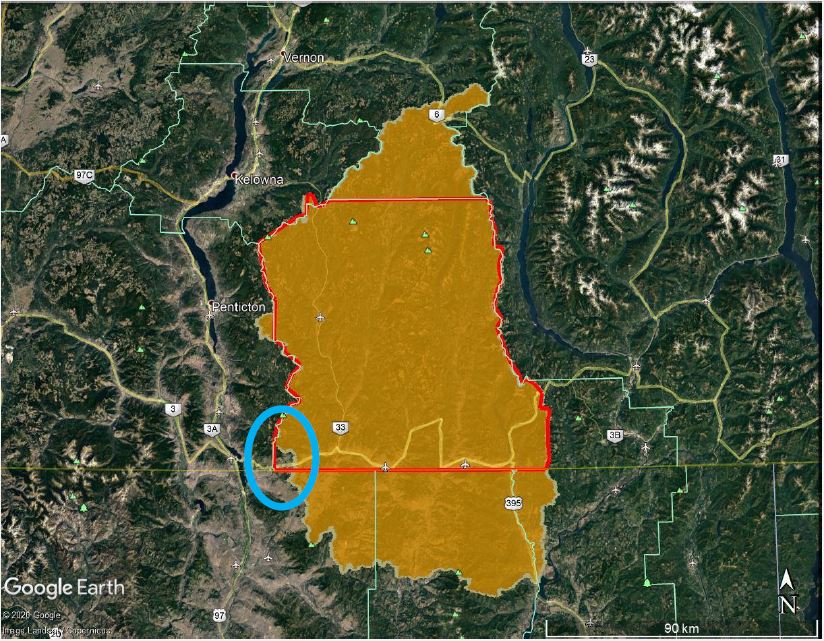
There is a 53km2 region in the southwest portion of the RDKB that is located in the Okanagan River watershed, covered by the Nine Mile Creek watershed (a tributary to the Okanagan River).

Blue circle shows the area in the RDKB (red outline) that is outside of the Kettle River Watershed (orange polygon).

The Nine Mile Creek watershed covers the RDOS, and enters the US before it feeds into the Okanagan River.

Yellow polygon outlines the Canadian portion of the Nine Mile Creek watershed.

RDKB had a Drought Management Plan produced by Associated Engineering for the RDKB portion of the Nine Mile Creek watershed. A public meeting will be held in November to present this to the residents of this watershed. The RDKB has no authority to regulate water or water use in the Nine Mile Creek watershed, this report is for information only and outlines the best information we had available at the time of the review. This document is to be considered a living document, and new information will be added as it becomes available and RDKB has capacity to update the document.

Nine Mile Creek Drought Management Plan (2022)

Sept 2nd drought update

With our region’s cooler spring temperatures and increased precipitation, we continue to see a buffering from these hotter summer temperatures. Attached is a quick summary of conditions here in the Boundary watersheds. I have included links to each map so hopefully they can be accessed individually. Three of the five Kettle River sub-watersheds have been moved to a level 3 (severely dry) drought classification. Under this level, the Province recommends a 30% voluntary reduction of water use. As our stream water levels continue to drop, the streams are being monitored very closely. 

The September drought update can be downloaded from the link below.

Any questions, please reach out to [email protected]